Drifting Through Deep Time
Two kinds of drifting, on one timeline. Continents drift apart, collide into Pangaea, and break up again. Spores and pollen drift on wind and water, as plants come ashore and spread across the land. Press play to watch 539 million years unfold, from the base of the Cambrian to today.
How the map is drawn
Today's rocks and ocean floor are carried back to where they formed on a published plate tectonic reconstruction. Each rock is shaded by how long ago it formed (pale parchment while forming, fading as younger rock accumulates, hatched black where no record survives), or by period colour. Ocean floor is born at the ridges and sinks at subduction zones.
Much of this hub was compiled with the help of AI, so errors are likelyFor educatorsThose errors make a ready-made teaching tool: students check entries against the scholarly literature, find what's wrong, and fix it. Read about the teaching philosophy →. Please check anything important against the original sources.
Map key
Map
Timeline details
Map options
Plant phylogeny
Each spoke is a plant family, growing out from its first appearance and glowing white at its tip while it lives; extinct families turn a dark shade of their group colour. In the fixed layout every family keeps its place, with lineages yet to appear drawn faintly; switch to Blossoming to let only the lineages alive at that moment share the circle. Radius is time (centre 480 Ma, rim today; the dashed ring is now). Hover to light up a plant group and see a family’s photos, pollen and natural history; click to pin it. Scroll or pinch to zoom; family names appear from about 5× zoom. Violet marks Rafflesiaceae, an extreme outlier; dotted branches are placed by classification or from the literature.
Hover over a family in the tree to see its plants, flowers, pollen and natural history; click to pin it.
Family counts
Bars: 5-Myr steps. Above the axis, families living at that time; below, families that have gone extinct by then. Colour = the period of each family's first appearance. Families from the Paleobiology Database; topology from the Open Tree of Life. First appearances need at least 3 occurrences from 2 publications; isolated older records are set aside (dotted). Angiosperms are counted from 140 Ma and seed plants from 372 Ma at the earliest.
Study table
Build a table of studies
Filter the 21,900 paleobotanical and palynological studies by evidence, preservation, setting and time, then browse, sort, export, or jump to any study on the map. Within a group, choices combine with OR; across groups, with AND.
| Site / collection | Age | Interval | Evidence | Preservation | Setting · lithology | Country | Reference | DOI / data |
|---|
Spores & Pollen Through Time
A series of short charts that follow the cells plants use to reproduce. They show common ancestry, descent with modification, and new functions. Each opens on its own; the buttons move the globe and the tree to that moment.
★ Three threads through the rocks: an overview 470 Ma to today
Read the record of spores and pollen from the bottom of the rock column to the top and three sequences unfold side by side: what the grains look like, how sperm reach the egg, and what the grains do. In each, a new stage appears only after the one it builds on, and the older stages carry on alongside: new branches grow from old ones, which is what descent with modification predicts.
Cryptospores and little else; then simple trilete spores; then elaborate trilete and monolete spores; then saccate and bisaccate pollen; then single-furrowed and tricolpate grains; then triporate grains; then variations on variations.
For 100 million years, swimming sperm only. Then seeds: a pollination drop draws the grain in, a tube feeds, and swimming sperm are released inside (as in Ginkgo and cycads today). Then tubes deliver non-swimming sperm straight to the egg: conifers, Gnetales, flowering plants.
Cryptospores stuck in fours; spores that separate and travel; heterospory, with large female and small male spores; then pollen: a male spore carried to a female spore that stays on the parent, inside a seed. Each step changes what the grain is for.
Bars start at approximate first appearance and stay on (paler) while the stage survives. Dotted starts are uncertain: when tubes first delivered non-swimming sperm is not known from fossils. The charophyte line is a separate lineage of algae, shown for comparison. Each stage is explained in the charts below.
1 Charophytes: the algae that came ashore from before 470 Ma to today
Land plants grew out of freshwater green algae. Their nearest living cousins are the charophytes: stoneworts that carpet clear lakes, flat discs on pond reeds, and the slimy filaments and desmids of every ditch. They are not our ancestors, but they inherited from the same ancestor, so what they share with land plants shows what that ancestor already had.
1 · Who they are, and where each shared feature appeared
Branching after phylogenomic studies of thousands of genes (Wickett et al. 2014, PNAS 111: E4859–E4868; One Thousand Plant Transcriptomes Initiative 2019, Nature 574: 679–685), which place the Zygnematophyceae (desmids, Spirogyra, Zygnema) as the sister group of land plants. Where exactly each feature arose is simplified; some were later lost.
2 · The shared toolkit: common ancestry
| Feature | What it does | Charophytes | Land plants |
|---|
3 · Descent with modification: one extra step in the life cycle
In charophytes the fertilized egg (zygote) is the only cell with two sets of chromosomes. It sits out hard times in a tough wall, then divides by meiosis straight away into four new cells. Land plants added one step: the zygote first grows into an embryo, then a whole new body (the sporophyte), and only later does meiosis happen, in a sporangium, making spores in groups of four. The tough wall moved from the zygote to the spores, where its job changed from surviving in place to travelling through dry air. Every trilete or monolete scar is the mark of that four-way split (see chart 3).
Sporopollenin-like wall material in charophyte zygotes: Delwiche, Graham & Thomson 1989, Science 245: 399–401 (Coleochaete). Molecular clocks put the origin of land plants in the middle Cambrian to Early Ordovician, before the oldest spores (Morris et al. 2018, PNAS 115: E2274–E2283).
4 · A fossil you can recognise for 420 million years
Stoneworts coat their egg (oogonium) in spiralling cells that lay down lime. The calcified case, a gyrogonite, is about half a millimetre to a millimetre long and fossilizes well, with its spiral still visible.
Gyrogonites appear in the late Silurian, at about the time the first vascular plants appear, and run through to today. The living order, Charales, has five spiralling cells; extinct Paleozoic orders had more cells with the opposite twist, or cells that ran straight up. A body plan held for over 400 million years, with the details changing along the way.
Because stoneworts live only in fresh to brackish water, gyrogonites mark ancient lakes and lagoons, and their changing species are used to date lake beds of the Mesozoic and Cenozoic.
Feist et al. 2005, Treatise on Invertebrate Paleontology Part B, Charophyta. Gyrogonite drawings are schematic.
Descent runs both ways. The Zygnematophyceae are the closest living relatives of land plants, yet they have lost the swimming sperm and the egg kept on the parent that stoneworts and land plants share. They mate by joining two cells through a tube (conjugation). Closeness of kinship and similarity of appearance are not the same thing: the evidence is in the shared genes and the pattern of gains and losses on the tree.
2 From trilete to triporate: how the exit moves and multiplies 470 Ma to today
Every spore or pollen grain needs a way out: a thin place in its wall where it opens, or where the pollen tube grows out. That aperture also lets the grain fold and unfold as it dries and wets (harmomegathy). Follow where the aperture sits and how many there are, and the branches of the plant tree fall into place.
1 · Apertures on the family tree
The last 150 million years are stretched out on this tree, because that is where most of the change happens. Click a lineage for its grains; fossil grains sit at their age, living grains at the tips.
Micrographs: Halbritter et al. 2018, Illustrated Pollen Terminology, CC BY 4.0 (living grains, and Miocene fossils from Austria and China), and USGS PP 1479 (public domain). Tree after APG IV (2016) and seed-plant phylogenomics; first appearances approximate, from pollen where possible.
2 · Near face to far face to the equator
A spore opens through the scar where it touched its three sisters in the tetrad (trilete Y, or one monolete line). The aperture is a by-product of how the four cells were packed.
Seed-plant pollen moved the exit to the opposite, outer face: a single furrow (sulcus), or a pore (ulcus) in Amborella and grasses. This is the face that meets the ovule or stigma. Most gymnosperms and the earliest flowering plants share it.
Eudicots place three furrows around the equator, where each grain met its sisters in a tetrahedral tetrad (Fischer's rule). More exits mean the tube can start whichever way the grain lands. Some botanists link this to the eudicots' success: they are about three quarters of all flowering plants (Furness & Rudall 2004, Trends in Plant Science 9: 154–158).
3 · One origin, or many? Homology and convergence
Three furrows evolved once. Tricolpate pollen appears in the fossil record about 125 million years ago and marks a single lineage: the eudicots were even first named “tricolpates” for it (Doyle & Hotton 1991). One shared, unusual feature in one branch is the signature of common ancestry.
Three pores evolved many times. The same triporate design turns up in families that are only distantly related, each with tricolpate or tricolporate relatives of its own. Natural selection reached the same answer again and again: convergence.
Losses count too. Laurels (Lauraceae) lost the aperture entirely: their thin-walled grains have no fixed exit. Wind-pollinated birches, walnuts, grasses and goosefoots all ended up with small, smooth, porate grains, a package suited to wind, reached separately in each lineage. A feature can come, go or reappear; kinship is read from the whole pattern across the tree, not from one character.
3 Floats, drops and tubes: from spores to saccate pollen about 365 Ma to today
Every land plant starts life as a spore made in a group of four. The scar where the four touched (a trilete Y, or a single monolete line) is where the spore later opens. Seed plants kept that inheritance and rebuilt it, step by step, into pollen: a grain that travels to the ovule, floats into it and grows a tube.
1 · Grains on the family tree
Each bar is a lineage's fossil range on the same timescale as the globe; its spore or pollen type is drawn at the end. Read it as a branching tree, not a ladder: living ferns and clubmosses are as modern as pines, and sacs appear, spread and are lost again on different branches. Click a lineage for details and real grains.
Where the debate is. Seed-plant cladistic analyses generally find the medullosans branching off early, and the bisaccate callistophytes and glossopterids nearer the living seed plants (Hilton & Bateman 2006, J. Torrey Bot. Soc. 133: 119–168; Doyle 2006, same volume, 169–209). If so, two sacs evolved once, on the line leading toward the living seed plants, and were later lost in cycads, Ginkgo and flowering plants. Which extinct group lies closest to flowering plants is still argued: glossopterids, Caytonia, Bennettitales and Pentoxylon have each been proposed, and molecular data cannot test it because none of them left DNA. A tree shows which lineages are closest relatives, not which fossil was an ancestor.
Tree after recent phylogenomic and fossil syntheses; extinct groups placed from morphology, with dotted lines where their position is debated. Ages approximate. Drawings: schematic, not to scale. Black-and-white micrographs: U.S. Geological Survey Professional Papers 1479 and 1486 (Kosanke 1988), public domain; figure numbers are the original plates'. Colour micrographs: living plants, Halbritter et al. 2018, Illustrated Pollen Terminology, CC BY 4.0.
2 · Why sacs? Floating up the pollination drop
Many gymnosperm ovules point downward and put out a pollination drop, a bead of fluid at the opening (micropyle). Pollen that lands in it is drawn inside as the drop is taken back.
Air-filled sacs make a grain float. In water the sacs ride uppermost, and because the sacs sit on the side where the grain germinates (the distal face), the grain rises into the ovule with that side facing the nucellus, where its tube must grow. In experiments, saccate grains float up into the ovule while grains without sacs sink or stay in the drop (Leslie 2010).
A new function from an old part. The sacs are a split in the outer wall layer, the same wall a spore has. A structure inherited from spores has taken on a job that free spores never had.
Tomlinson 1994, Int. J. Plant Sci. 155: 699–715. Leslie 2008, Int. J. Plant Sci. 169: 1038–1045. Leslie 2010, New Phytologist 188: 273–279.
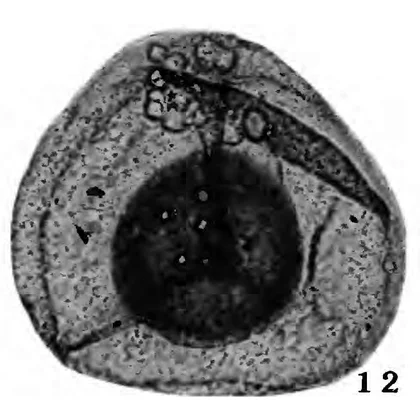
Similar is not the same as related. Endosporites, a spore of Pennsylvanian lycopsids (USGS PP 1486, pl. 1 fig. 12), also has an outer wall layer that stands away from the body like a sac. Lycopsids are not seed plants, so this sac arose separately. A single trait can be convergent. What shows common ancestry is a whole set of traits that line up together through time: the tetrad scar, the wall chemistry, the position of the opening, then sacs, then the tube.
3 · How sperm reach the egg: a ladder with living rungs
One ladder, or two climbs? (open question) The rungs read like a single sequence, but the family tree says otherwise. Molecular trees put all living gymnosperms on one branch and flowering plants on the other, with Ginkgo and cycads (feeding tube, swimming sperm) inside the gymnosperm branch. So a tube that carries sperm right to the egg (siphonogamy) probably evolved at least twice: once in conifers and Gnetales, and again in flowering plants, where the tube also grows down through a stigma and style. What may be shared is the older step, a tube that anchors and feeds: Callistophyton grains about 300 million years old already grew one. Same destination, reached on separate branches: convergence built on a shared starting point.
4 · Spotlight: the glossopterids
Glossopteris and its relatives were seed plants with tongue-shaped, net-veined leaves. They dominated the cool, swampy forests of Gondwana through the Permian (about 299–252 Ma) and built much of the coal of India, Australia, southern Africa and Antarctica. Their pollen is bisaccate with ribbed (striate) bodies, the type known as Protohaploxypinus.
Two lines of evidence meet here:
- Drifting continents. The same leaves turn up on continents now oceans apart, a key early argument for continental drift (Wegener; du Toit). Jump to 270 Ma and the globe shows them as one landmass.
- Swimming sperm inside a seed plant. Permineralized ovules from the Permian of Queensland have been reported to hold pollen with multiflagellate swimming sperm, like those of living Ginkgo and cycads (Nishida, Pigg & Rigby 2003, Nature 422: 396–397). If confirmed more widely, glossopterids sat on the middle rung of the ladder: seeds and pollen tubes, but still swimming sperm.
5 · “Transitional forms”
The first seed plants (Late Devonian, about 365 Ma) and the medullosan seed ferns of the coal swamps shed pollen that still opened through the spore's tetrad scar on its near (proximal) face. These grains do a pollen grain's job with a spore's body.
Living intermediates. Their pollen grows a tube, but the tube anchors the grain and feeds on the ovule for weeks to months; then it bursts and releases large swimming sperm. Cycad sperm, up to about 0.4 mm across, are the largest sperm of any plant (Hirase 1896, Ginkgo; Ikeno 1896, Cycas).
Pollen of the Pennsylvanian seed fern Callistophyton (bisaccate, Vesicaspora type) has been found inside ovules with tubes growing from the germinating side (Rothwell 1972, Science 175: 772–774): the tube is about 300 million years old.
An honest limit: soft tissues rarely fossilize, so where a fossil group sits on the sperm ladder is usually inferred from its living relatives and from rare permineralized finds.
4 How many ways to be a pollen grain? six slices through the rock record
Take everything plants were shedding at six moments in Earth's history and count the different kinds. Each slice holds the earlier kinds, some changed, some gone, plus new ones built from them. The number of ways to be a spore or pollen grain grows from older rocks to younger ones. That is what descent with modification predicts: new forms branch off existing ones, so variety accumulates. Independent creation of each form predicts no such pattern.
1 · The slices
Feature lists simplified and approximate; a feature is listed in a slice if grains of that kind are known from rocks of that age somewhere in the world. Micrographs: USGS PP 1479 and 1486 (public domain) and Halbritter et al. 2018 (CC BY 4.0). Dashed frames are drawings where a real grain photo is still wanted.
Where the grains come from: rocks and the places they formed
Outcrop and specimen photos: Wikimedia Commons, credited on each. Drawings of each setting are schematic. Spores and pollen survive best where plants grew next to still water or peat, and where little oxygen reached the bottom.
2 · Counting the ways
Each row is a feature, each column a slice: a filled cell means grains of that kind occur. New rows switch on in younger slices, building on rows already on. A few switch off (Paleozoic prepollen, Classopollis): variety grows overall, but not every form is kept. Part of the rise reflects how much more young rock survives, but the order in which features appear follows the branching of the tree in charts 2 and 3.
3 · Colour: a rough clue to burial, and so to relative age
Spore and pollen walls darken with heat, from colourless through yellow and brown to black. Grains high in the rock column have seldom been buried deep enough to cook, so they stay pale; deeply buried old grains are usually darker. Colour therefore tracks burial history: on average it hints at age, but an old grain from shallow rock can be pale (the Middle Devonian spores of Cromarty are a well-known example), and heating a modern spore in the lab darkens it within hours (Kent et al. 2025). Ranges shown are illustrative; they will be replaced by grains scored in the Spores Through Time catalog.
4 · Alongside: the stonewort record
The charophyte algae of chart 1 tell a parallel story in their egg-cases. Devonian stoneworts belonged to extinct orders with straight or reverse-spiralled cells; the living order, Charales, appears later and diversifies through the Mesozoic, including the Clavatoraceae of the Jurassic and Cretaceous with their elaborate outer “utricle”; today's Chara, Nitella and Tolypella are its survivors. Turnover as well as growth: a separate lineage, descending with modification on its own track.
Feist et al. 2005, Treatise on Invertebrate Paleontology Part B, Charophyta. Gyrogonite drawings schematic.
5 Three roads to wood about 390 Ma to today
Trees evolved more than once. Within about 30 million years of the Middle to Late Devonian, three separate plant lineages grew into trees, each with its own way of thickening a trunk. They became trees independently, so their wood is built differently, yet their spores still show the shared ancestry of all land plants. Same job, three solutions: convergence. Shared reproductive cells underneath: common descent.
1 · Three lanes on one timeline
Bars: time each lineage formed trees. Photos sit at the age of the fossil (Pennsylvanian examples, not first appearances); the living relative is at today. Fossil photos: Wikimedia Commons; living plants: iNaturalist; fossil spores: USGS PP 1479 and 1486 (public domain). Credits below.
2 · How each one builds a trunk
| Scale trees | Horsetail trees | Lignophytes |
|---|
After Spicer & Groover 2010, New Phytologist 186: 577–592, on the separate origins of the vascular cambium. Cross-sections schematic.
3 · The fourth road: a tree without wood
The oldest known trees made no wood at all. Wattieza (the trees of the Gilboa fossil forest, New York, about 385 Ma) was a cladoxylopsid, a fern relative some 8 m tall, whose trunk was a ring of many separate water-conducting strands held in soft tissue, crowned with branches instead of leaves (Stein et al. 2007, Nature 446: 904–907). Tree ferns and palms do the same trick today: tall trunks with no wood ring. Height has been reached by many routes; true wood by fewer.
What the spores show. All three tree lineages kept the basic land-plant spore: a wall of sporopollenin, made in fours, marked with a tetrad scar (chart 3). Scale trees and horsetail trees went no further than free spores, though both experimented with large and small spores, and scale trees even with a seed-like structure (Lepidocarpon). Only the lignophyte road continued into seeds and pollen. The trunks are convergent; the spores reveal the shared starting point.
6 Insects, wings and pollinators in preparation
Wings as another key innovation, insect diversity through time, and plant–pollinator interactions.
Notes & sources
What moves
Each dot is a 0.5° cell of today's geological map (1° for ocean floor), assigned to its tectonic plate and rotated with the Merdith et al. (2021) full-plate model. Ocean floor appears only once its crust exists; continental fragments appear when their plate does. Positions are interpolated between 5-million-year steps. Scroll or pinch to zoom, drag to pan, double-click to zoom in; dots grow with zoom because the data are sampled every 0.5° (1° at sea).
What glows
A cell is pale parchment while its surface rock is forming (pure white is kept for ice), according to the age range on the world geological map, then greys with the time since it finished forming. In period-colour mode it glows in its period colour instead. With columns included, buried layers recorded in boreholes and sections glow too, so you can watch deposition in places now covered by younger rock. Loosely dated units glow faintly for longer.
The empty oceans
Ocean floor is made at spreading ridges and consumed at subduction zones. Most of the floor of the ancient Pacific (Panthalassa) and of older oceans has since sunk into the mantle, so no rock survives to place on the map; those areas are dark. The plate boundaries are drawn from the model itself, so you can watch the trenches that consumed it. Rock eroded from the continents is likewise gone. Before about 540 Ma the reconstruction is much less certain. Two outlines move with the plates. The pale edge and faint wash mark continental crust out to the continent–ocean boundary, from the plate model's own continental polygons; they include crust that no longer reaches the surface, such as Greater India, the now-vanished northern part of the Indian plate that was underthrust or subducted beneath Asia. The thin dark line is today's coastline (Natural Earth 1:50m), carried along for recognition, not an ancient shoreline.
Sources
Ocean depth from crust age: Parsons B. & Sclater J.G. (1977) J. Geophys. Res. 82, 803–827 (depth ≈ 2,600 m + 345 m·√age, levelling near 6,400 m); shelf depths from SRTM15+. Deep-time sea level (66–250 Ma, applied to continental shelves only): Haq B.U., Hardenbol J. & Vail P.R. (1987) Science 235, 1156–1167, via Miller et al. (2005) at NOAA NCEI; its amplitudes are larger than most modern estimates. Glaciations are mapped ice regions tied to today's positions of their glacial deposits, so the ice moves with its plate: the Late Ordovician–early Silurian (Ghienne et al. 2007; Le Heron & Dowdeswell 2009), Late Devonian (Isaacson et al. 2008), Late Paleozoic Ice Age episodes about 368–260 Ma (Fielding et al. 2008; Isbell et al. 2012; Montañez & Poulsen 2013), the East Antarctic ice sheet from 34 Ma and all of Antarctica from about 14 Ma, and Quaternary ice sheets from 2.7 Ma whose Last Glacial Maximum outlines (Ehlers et al. 2011; Dalton et al. 2020; Hughes et al. 2016) grow and shrink with sea level. Outlines are simplified, and pre-Quaternary ice extents are approximate. Orogeny ages are approximate. Biogeographic lines after Wallace (1863), Huxley (1868), Weber and Lydekker (positions approximate); botanical boundaries after van Steenis. Barrier and land-bridge ages are approximate and several are debated. Family photos: iNaturalist research-grade observations under CC0, CC BY or CC BY-SA, credited on each card. Pollen micrographs: Halbritter et al. (2018), CC BY 4.0. Plant tree: family first/last appearances from the Paleobiology Database; branching order from the Open Tree of Life synthetic tree (Hinchliff et al. 2015, updated; angiosperms consistent with APG IV 2016); extinct families not in the synthesis are attached to their order, class or division as polytomies. Branch points sit at the oldest first appearance among their descendants (a minimum age). Studies: Paleobiology Database (paleobiodb.org, CC BY 4.0) plant collections and references, with studies flagged as palynological from their titles; Neotoma Paleoecology Database (neotomadb.org, CC BY 4.0) pollen datasets; Holocene diagrams use Neotoma counts, % of trees, shrubs and upland herbs, 250-year means. Volcanic provinces: Johansson L., Zahirovic S. & Müller R.D. (2018) Geophysical Research Letters 45, doi:10.1029/2017GL076691 (via GPlates); flashes start at each province's onset age. Ocean anoxic events: Jenkyns H.C. (2010) G-cubed 11, Q03004; Devonian events after Kaiser S.I. et al. (2016) Geol. Soc. London Spec. Publ. 423; ages approximate. Stages: International Chronostratigraphic Chart via Macrostrat. Sea level: Miller K.G. et al. (2020) Science Advances 6, eaaz1346, and Spratt R.M. & Lisiecki L.E. (2016) Climate of the Past 12, 1079–1092, via NOAA NCEI; the stack is tapered to 0 m over the last 6 kyr. Elevation: SRTM15+ v2.7 via the GMT data server. Grey scale: Sadler P.M. (1981) Sediment accumulation rates and the completeness of stratigraphic sections, Journal of Geology 89, 569–584. Plate model: Merdith A.S. et al. (2021) Earth-Science Reviews 214, 103477, via GPlates; continental crust outlines are its continental polygons (GPlates model registry). Coastlines: Natural Earth 1:50m (public domain). Geology: Chorlton (2007), GSC, via Macrostrat (CC BY 4.0). Columns and drill cores: Macrostrat (CC BY 4.0). Seafloor age: Seton et al. (2020). Coastlines: Natural Earth. Colours: ICS chart. Projection: Equal Earth.
Ethical statement
A personal note
This statement represents my personal perspective, which I do not expect or require anyone to adopt for themselves. The tools I use to build this work have a destructive side:
- Water
- Data centers use large amounts of water for cooling, and in dry regions they can draw down the local groundwater supply.
- Mining
- Rare earth elements, cobalt, lithium, copper, and tantalum are dug from landscapes at real cost to ecosystems, and too often to the people who mine them, sometimes including children.
- Energy
- Training and running AI, and powering every device, still depends heavily on electricity from fossil fuels.
- Manufacturing
- Making chips consumes huge amounts of energy and ultrapure water, and releases fluorinated gases such as nitrogen trifluoride and sulfur hexafluoride, which trap thousands of times more heat than carbon dioxide and can persist for centuries to millennia.
- Electronic waste
- Devices become obsolete and are quickly replaced. Much of the waste from this turnover is shipped abroad and taken apart by hand, exposing workers to toxic metals.
- Hidden labor
- AI systems rely on low-paid workers who label data and filter out disturbing content, often in the Global South.
- Other people's work
- These models were trained on writing, art, and research made by people who were rarely asked and seldom paid.
- Noise
- Data centers run cooling fans and backup generators around the clock. People living nearby describe a constant hum that disrupts sleep and daily life.
- Local communities
- New data centers claim land and strain power grids, which can raise electricity costs for the people living nearby.
Most of these costs fall on people and places far from me, who did not choose them. No personal choice settles that. The real answers are collective: fair pay and safe conditions for the people who mine, build and label; consent and payment for the people whose work trains these models; and limits on the water and energy that data centers draw.
It would be hypocritical to ask others to give these tools up while I continue to use them. Whether or not these means are justified rests on the ends that I hope they facilitate:
- the collective ownership of freely shared information, and
- the collaborative creation of high-quality educational resources that help people understand ecosystem function, organismal biology, human ecology, and climate processes.
Part of my reason for creating this work and sharing it openly is to avoid doubling efforts that make use of these tools. When knowledge is shared, the cost of building it is paid once instead of over and over.
When I looked, there did not appear to be a non-commercialized searchable network of people, organizations, teaching tools, and philosophical dispositions so as to facilitate connection based on curiosity, purpose, and study subject.
If you know of work like this, please connect. I would much rather join forces than duplicate.
Sources
- Water: Pengfei Li, Jianyi Yang, Mohammad A. Islam and Shaolei Ren, "Making AI Less 'Thirsty'" (arXiv, 2023, revised 2025).
- Mining: Amnesty International, "Exposed: Child labour behind smart phone and electric car batteries" (2016).
- Energy: International Energy Agency, Energy and AI (2025).
- Manufacturing: IPCC AR6 Working Group I, Chapter 7 Supplementary Material, Table 7.SM.7 (2021); US EPA, Subpart I (Electronics Manufacturing) information sheet (2024).
- Electronic waste: ITU and UNITAR, Global E-waste Monitor 2024.
- Hidden labor: Billy Perrigo, "OpenAI Used Kenyan Workers on Less Than $2 Per Hour", TIME (2023).
- Other people's work: NPR, "Anthropic pays authors $1.5 billion to settle copyright infringement lawsuit" (2025).
- Noise: Associated Press, "As Data Centers Proliferate, Neighbors Knock the Noise" (2022).
- Local communities: CEPR VoxEU, "How data centres affect electricity prices, and whom".
- Further reading: Mark Coeckelbergh, Green Leviathan or the Poetics of Political Liberty (Routledge, 2021).
The same statement appears in The Open Commons of Learning.